
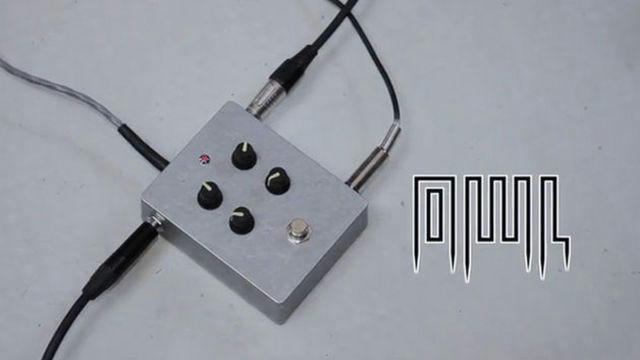
Open hardware effects pedal on Kickstarter
Martin sez, “Rebel Technology launches a Kickstarter to fund the OWL reprogrammable effects pedal: an open hardware, open source effects stompbox with a potentially unlimited library of effects written in C++ and powered by a powerful ARM Cortex M4 processor. It allows musicians to load any available effect or effect chain from their computer onto the pedal. Martin, Tom and Giom, the engineers behind the project, met each other at the London Hackspace in Hoxton. They all come from different backgrounds: Tom is a sound engineer and university lecturer, Giom a DSP engineer and musician, and Martin a software and hardware engineer. They have a shared passion for audio signal processing and hacking.”
It’s £165 and up to get your own fully assembled pedal (assuming they ship, as with all Kickstarters, caveat emptor).
The OWL is an open source, open hardware, reprogrammable effects pedal designed for musicians, coders, and hackers.
With some coding and DSP knowledge, the OWL can become any kind of audio effect that you can imagine. Effects can be combined in any number of ways by chaining or switching between them.
Using a provided C++ framework, effects can be developed, compiled and loaded to the on-board ARM Cortex M4 chip with no proprietary tools or hardware-specific knowledge.
The OWL gives coders the chance to implement their own effects and become part of an open-source audio developer community. For those who don’t write code there is a growing collection of patches available for immediate download and use in the patch library.
With a strong emphasis on open-source hardware and software, the OWL is perfect starting point for anyone wanting to experiment with embedded audio, or for those wanting to to learn more about audio programming and Digital Signal Processing in general.
For musicians:
• Load patches from your computer via USB • Collection of sample patches available and growing • Standard guitar pedal inputs/outputs
For developers:
• Write code for a hardware DSP architecture in plain C/C++ • no hardware specific coding required • Open source platform and tool chain • Access to all low level ARM functions