
SoundWorks Collection Interview Series - Playstation Music Group
This week with spoke with the Playstation Music Group including Senior Music Manager Jonathan Mayer, Music Producer Matt Levin, and Senior Music Editor Scott Hanau about their working supporting various video game titles including God of War, Uncharted, The Order, The Last of Us and InFAMOUS.
About the Sony Playstation Recording Studios:
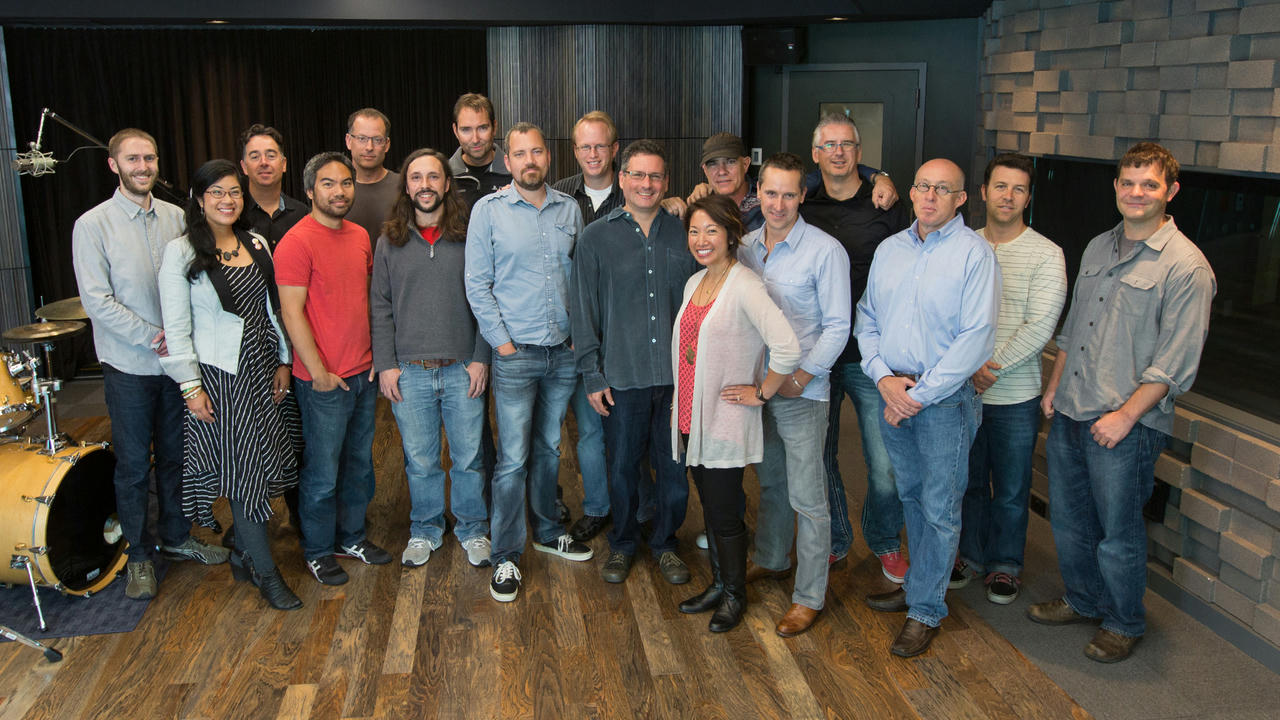
Most, but not all, of the San Mateo-based Sony PlayStation Music and Sound crew in the new facility’s live recording room, which can hold up to 35 pieces comfortably, with windows to both the API and Foley rooms and a glass wall allowing for natural light.
There really are no precedents for what Sony Computer Entertainment America has done over the past seven years in its ongoing commitment to raising the quality of game sound. Other developers and publishers have built world-class rooms and facilities, adapting to the sophistication and complexity of modern production chains and more powerful game engines. But nobody has done it like Sony.
To understand the full scope of what Sony has quietly developed in audio up and down the California coast, you have to go back those seven years, to when the company built its first true professional audio rooms in the U.S., in their San Diego facility. At the time, PS2 was maintaining its dominance and PS3 was soon to launch. It was still a game console industry, primarily, and it wasn’t uncommon for a title to bring in $1 billion or more. Audio, both creation and playback, was considered a major part of the format’s success, and the company backed the construction of 20 5.1 edit Pods, a tracking room, a Foley room, voice booths and three mix stages between its San Diego and Foster City, Calif., locations. A couple of years later, identical Pods were added to the Santa Monica development facility.
Fast forward to today, with the launch of PS4 less than three months away, and Sony has upped the ante again, in August opening 17 new edit Pods, an API control room, a D-Control control room, a Foley room, a sweet-sounding live room that holds up to 35 pieces comfortably, and the 7.1 Euphonix S5 mix stage pictured on this month’s cover—all as part of the company’s Northern California relocation from Foster City to San Mateo, a half-mile away.
Word first came down from management that the facilities would be relocating about two years ago. While it meant tearing down world-class rooms and moving systems over (all without down time), it was seen as an opportunity to do it all again, on a larger scale, incorporating new technologies and design criteria to both increase the scope of the company’s in-house work and improve on interoperability, workflow and collaboration. It was also an opportunity to bring in natural light, improving the comfort and vibe for engineers and sound designers who often work 16- to 18-hour days in the last few week’s before a game’s release.
“It’s all about talent,” says Dave Murrant, senior director of product development service groups, who also spearheaded the initial build-outs in 2006. “You want to have an environment where they are inspired to be creative. Our previous rooms sounded great, and it broke our heart to leave them. When we approached this next round of build, we thought first of what we could do to enhance the experience for the people who create the sounds.
“Sony has always understood that quality is paramount, and their support of this facility is emblematic of this,” he continues. “They see all the awards on the games—God of War, Uncharted, Journey, The Last of Us—there has been such a high regard for the quality of the audio on PlayStation games, the executives knew it was important. It’s a big investment and we got their backing.”
The core group of the creative and design and integration teams that came together for the 2006 build was largely the same this time around: Murrant; Chuck Doud, director of music; Matt Lavine of Bug ID, system design and integration; SC Builders, construction; and Chris Pelonis, studio design and acoustics. Two years ago, they met and began going over plans, joined by music engineering manager Marc Senasac and manager of sound and dialog in San Mateo Ken Felton, among a few others. The approach, by all accounts, was extremely collaborative. The goal was to improve on what they had learned over the years, recognizing that game sound production is an ever-changing target and building with future-proofing in mind.