
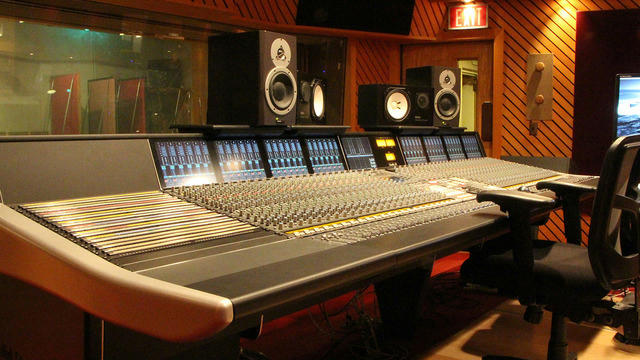
SoundWorks Collection Interview Series - Jeffrey Wood - Studio Director of Fantasy Studios
This week we talk with Studio Director Jeffrey Wood about his work at Fantasy Studios in Berkeley, CA and the incredible roster of artists that have come through this legendary studio.
Fantasy Studios is at the Zaentz Media Center, known for its recording of award-winning albums such as Journey’s Escape and Green Day’s Dookie. Built as a private recording studio for artists on the Fantasy Records label in 1971, it was opened to the public in 1980 for recording, mixing and mastering. Fantasy Studios continues to operate as a full-service recording studio for the music, television, film and gaming industries.
ABOUT JEFFREY WOOD:
In the last 25 years Jeffrey has established himself as an international music producer, engineer, composer, and label consultant. He has worked for labels such as Warner Brothers, Reprise, Virgin and Chrysalis. Early in his career Jeffrey relocated to London where he produced music for labels and film, as well as being hired to open the UK office for Los Angeles based company Malibu Management.
Five years later, upon locating in Los Angeles, he signed with Polygram Publishing as an artist and writer, as well as continuing to produce for labels. In 1995 he became a producer working in residence at Fantasy Studios. Jeffrey has produced music in 11 languages and worked in studios throughout the states and Europe. He has worked with artists such as the Housemartins, Luka Bloom, Penelope Houston, among many others. He also produced Erika Luckett’s “Unexpected,” which was awarded the “Album of the Year” in the World music competition of Just Plain Folk, the largest music organization in the world. The album was also voted the 2008 “International Music CD of the Year” by the World Arts Celebrity Journal. He has also co-produced “Approximately Nels Cline”, a nationally released film by Academy Award winner Steven Okazaki examining the creative process in the recording studio, featuring the eloquent guitarist of Wilco.
Jeffrey was named Studio Director of Fantasy Studios at the end of 2007. Since then he has worked with many notable recording artists, including clients listed on the Fantasy website since 2007. In addition to bringing 25 years of experience with him, Jeffrey provides a wide range of services including production, recording and musical expertise, budget planning, and music industry insight to help make the Fantasy recording experience the most rewarding experience possible.
ABOUT FANTASY STUDIOS:
Fantasy built Fantasy Studios to accommodate its growing roster, which remained primarily jazz artists but included some in rock, soul and disco. The building went up at 10th and Parker Streets in the western industrial area of Berkeley. Because of the source of funding, it was nicknamed “The House That Creedence Built.”[9] Fantasy was the most profitable independent record company in the U.S.[9] Jim Stern, who had served as producer for the Sons of Champlin and Van Morrison, was chief engineer from 1974 until 1981. Jesse Osborn was another early engineer along with Eddie Bill Harris and Don Cody.
Each of Fantasy Studios’ three rooms was built to serve a specific purpose:
Studio A At 1,344 square feet, Studio A could accommodate a traditional big band, and included a DeMedio console. Small audiences could be brought in to give a recording date the feel of a live album, as Keepnews did for a 1973 Cannonball Adderley date, resulting in the album Inside Straight. Studio A also had a projection booth, pull-down screen and portable mixing console that was built for film mixes. During those early years Fantasy also had a film unit and its films (mostly promotional pieces for the label’s artists) were mixed in Studio A. The film unit was headed up by Irving Saraf and Bob Zagone, two Bay Area documentary filmmakers. Feature films were mixed in Studio A as well, including Academy Award winners One Flew Over the Cuckoo’s Nest, Apocalypse Now, Amadeus and The English Patient.
Studio B Studio B, at 546 square feet, was used mostly for smaller acts and comedy records, and was typically used for overdub sessions. Like Studio A, it too used a DeMedio console.
Studio C Studio C was built expressly for CCR, with a separate entrance. Parts of their albums Mardi Gras and Pendulum were recorded there, and the Live in Europe album was mixed there. John Fogerty recorded The Blue Ridge Rangers in Studio C and was in residence there until he left Fantasy in 1974. At 888 square feet, Studio C was also the site of a film soundstage and Foley pits. Studio C was the only studio at Fantasy which used an API console. Studio C was closed to the public in 2008 with the space taken over by another Zaentz Media Center tenant.
Studio D From the profits of the 1975 Zaentz-produced film One Flew Over the Cuckoo’s Nest, Fantasy Studios expanded further in 1980 with the addition of an adjoining seven-story building which included a fourth recording room, Studio D. It also marked the point at which all rooms became open for use by the public for recording, mastering and film scoring.
The new Studio D was designed by Tom Hidley and constructed by Sierra Audio. The control room featured an automated Neve 8108 board, Hidley monitors, Ampex 16 and 24 track recorders and a Studer 24-track recorder. At 1,500 square feet, the live room was built with multiple interior surfaces (unlike the other three rooms): one side of the room featured bass traps, cork and rock on the walls for a “dead” sound; the other featured hard wood floors and ceiling, and mirrored walls for a more “live” sound.
One of first albums to be recorded and mixed in its entirety in the newly opened Studio D was Journey’s Escape, which reached #1 on the Billboard 200 Chart. The album contained such hits as “Open Arms” (which reached #2 on the Billboard Hot 100 List), “Who’s Crying Now” (reaching #4 on the Billboard Hot 100 List) and “Don’t Stop Believin’” (reaching #9 on the Billboard Hot 100 List). Fantasy Studios’ staff engineer Wally Buck worked as Assistant Engineer on the album.